Artificial Beauty
How Humans Define Feminine Beauty Through Culture, and How AI Shapes Our Perception.
AI Analysis
Article written by Yasmin Salih
Culture & Media
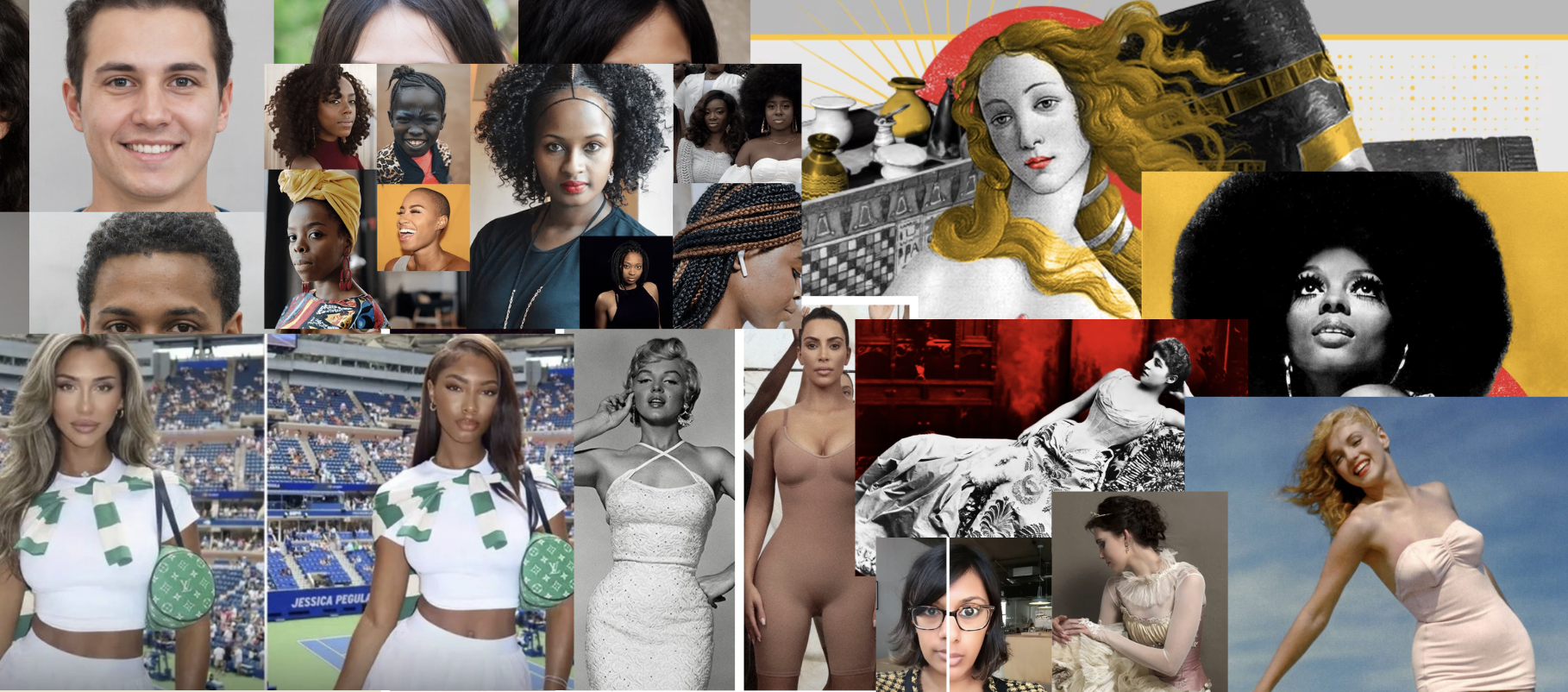
Image generation has taken over social media and our perception of beauty. While we as humans have individual opinions and perspectives on what we define as beautiful, a machine can only produce results that fundamentally are a reflection of our cultural inheritance…
The contemporary definition of feminine beauty is deeply entrenched in generations of racial bias and cultural influence. Beauty, while inherently subjective, is not formed without its predecessors; perception is shaped by the images, spaces, and narratives individuals are exposed to across both digital and physical environments. Modern beauty standards have been disproportionately rooted in whiteness, even as aesthetic elements originating within Black culture are routinely appropriated and recontextualized. Across elements such as fashion, hair, body image, and cosmetics, trends that emerge from the Black community are frequently celebrated when adopted by non-Black individuals, yet stigmatized as "ghetto" or unprofessional when expressed by their originators.
These socially constructed beauty standards do not remain confined to human perception. They are increasingly embedded in the technologies we interact with daily. The rapid proliferation of generative artificial intelligence and the cultural influence these systems exert on younger generations raises urgent questions about how definitions of beauty will continue to evolve. Generative AI systems, developed predominantly by white corporate institutions, have been trained on datasets that reflect the same racial hierarchies and stereotypes present in broader society–yet lack the capacity for the cultural immersion necessary to contextualize them. This raises critical lines of inquiry: How do AI-generated definitions of beauty diverge from, or reinforce, human ones? And what do these definitions reveal about the structural ways in which beauty standards are deployed against Black women?
As a digital cultural researcher, I have spent the past year examining how machines interpret the deeply humanistic concept of perception, particularly as it pertains to the female body. Tools such as SpaceX AI's Grok, Google's Gemini, and MidJourney each rely on foundational machine learning principles to generate images ranging in style from photorealism to animated caricature. Because many of these platforms are accessible at little to no cost, they extend to an effectively unrestricted user base the ability to generate images according to their own imagination. On its surface, this technology appears to inaugurate a new era of creative possibility. In practice, however, the unregulated proliferation of image generation has revealed a considerably darker trajectory: one marked by the sexualization and exploitation of women and minors. This pattern points to an underlying structural issue: rather than operating as neutral tools, these machines function as direct extensions of existing patriarchal and racialized power structures.
This dynamic is perhaps most visible in the case of Grok. Within the first few weeks of its public release, users on X (formerly Twitter) reported being inundated with softcore pornographic images of women generated without regard for the context, consent, or origin of the source photographs. More alarmingly, Grok reportedly generated upward of 230,000 images depicting child sexual abuse within its first three weeks of availability, prompting developers to introduce more stringent content regulation. Yet even under these new constraints, users have continued to circumvent safeguards, employing coded or suggestive terminology to sexualize women's photographs indirectly. That such exploitation persists despite active moderation suggests that the underlying vulnerability is not merely technical, but structural.
This structural vulnerability becomes clearer when situated within the demographics of the technology sector itself. In 2025, women of color constituted only 27.3% of U.S. tech workers in engineering and production roles, with Black women representing a mere 2.7% of that already limited figure. Such a stark underrepresentation raises a further and more pressing question: to what extent are the few women present in the industry represented at the level of leadership and decision-making, where design choices and safety priorities are actually set? At Google, parent company of Gemini, leadership positions remain disproportionately closed to women, and especially to women of color; by the end of 2025, only 7.4% of the company's technical workforce identified as African American. Read together, these figures suggest that the demographic composition of the industry is not incidental to the harms described above, but foundational to them. Until the field engages seriously with the risks unregulated AI poses to women's autonomy and to the reinforcement of racialized stereotypes, these systems will continue to generate imagery that reproduces, and amplifies, the very inequities embedded in the industry that builds them.
To probe this dynamic further, I conducted an experiment using Gemini, prompting the tool, absent any specified subject or context, to generate an image of what it considers "beautiful."
Gemini's response was, in one sense, the correct one: it noted that beauty is an inherently subjective concept, and asked me to define the term so that it could generate an image aligned with my own understanding. To extend the experiment, I continued the conversation using descriptors that I would personally characterize as beautiful, terms rooted in Black beauty and in conceptions of beauty that move beyond Eurocentric standards. The images Gemini produced followed my prompting accordingly (though notably, they never departed from a narrow body standard of thinness), and the tool registered my expressed preference toward Black beauty within the conversation. Having established this context, I chose to test Gemini's own default definition of beauty once more.
Using comparable prompting within the same conversation, I asked Gemini to generate an image of a woman it considered beautiful, independent of my prior input. The results are listed below. Even with the preferences I had just established, Gemini reverted to a definition of beauty aligned with whiteness and Eurocentric features, despite there being no meaningful difference in phrasing between this prompt and the one preceding it. This inconsistency was not isolated to my own testing: the same pattern emerged during a workshop I held at the University of Washington, in which participants prompted Gemini to generate images of what the tool defined as beautiful. Eighty-five percent of the resulting images depicted white women, all portraying thin bodies as the standard of beauty, styled across a range of fashion aesthetics. Notably, many of these generated women were placed in settings coded as "European-inspired," as though the environment itself were meant to complement the tool's underlying definition of beauty. These findings raise a pressing question: what does this pattern teach the average user about the boundaries of beauty, and, by implication, about those who fall outside Gemini's own default mold?
Taken together, these findings suggest that image generation does not invent bias so much as reflect and consolidate it. When cultural conceptions of beauty are already structured around anti-Blackness and the sexualization of women's bodies, machine learning systems trained on that culture are bound to amplify its influence rather than correct it. Yet this raises a further and more difficult question: if leaders within the AI industry remain unwilling to confront the racialized assumptions embedded in these tools, where might meaningful change originate instead? Organizations such as Black in AI and Girls Who Code offer one possible answer, working to position women, and particularly women of color, in leadership roles so that image-generation tools might be approached with a deliberately anti-racist framework from the outset. Still, addressing the exploitation of women's bodies in AI-generated imagery cannot be reduced to a single intervention. It demands a broader reckoning with where our understanding of beauty originates in the first place, a cultural task as much as a technical one, requiring us to interrogate not only our own biases but the harm those biases can inflict on communities of color, and not only with respect to the body, but to the environments AI constructs around it. As artificial intelligence continues to expand its influence across the technology sector, it becomes our collective responsibility to recognize the machine biases embedded within these tools, and to challenge the cultural assumptions from which they originate.