Centering Real-Time Road Information Through Conversational AI
Uber
Role:
Lead UI Engineer
UI Designer
Uber just needed to provide a space to listen
Team:
4 UX Designers
Uber Earner Research Team
Timeline:
6 Month Development
3 Month Research Process
Drivers Have Always Spoken to Each Other Through Other Means…
Drivers feel that a lack of a quick verification system during large-scale events creates a massive communication disconnect. It is for this reason that Uber approached our team with the objective of understanding how to make the drivers’ experience more reliable and less frustrating during these moments, so they could capture trip requests when it matters most.
How might we design the Uber driver experience to communicate real-time road updates during large-scale events, so drivers can make smarter decisions about navigation without relying on informal workarounds?
FIFA Will Bring Lots of Riders, Lets Get Uber Prepared
This matters especially now, with the 2026 FIFA World Cup coming to the United States, one of the largest recurring sporting events in the world, and the scale is hard to overstate.
United States
5.5 Million
Fans projected to attend during 2026
Qatar
3.4 Million
Total Spectators in 2022
For Uber, this is a significant opportunity in the US. Success would look like drivers completing more trips during large-scale event windows and feeling less frustrated navigating pickups in chaotic conditions.
Impactful Events in United States
396,144
In the first 90 days of 2026 (By Predict HQ)
Proposed Solution
Returning Road Knowledge Ownership Back to Drivers: Crowdsourced Information through Conversational AI
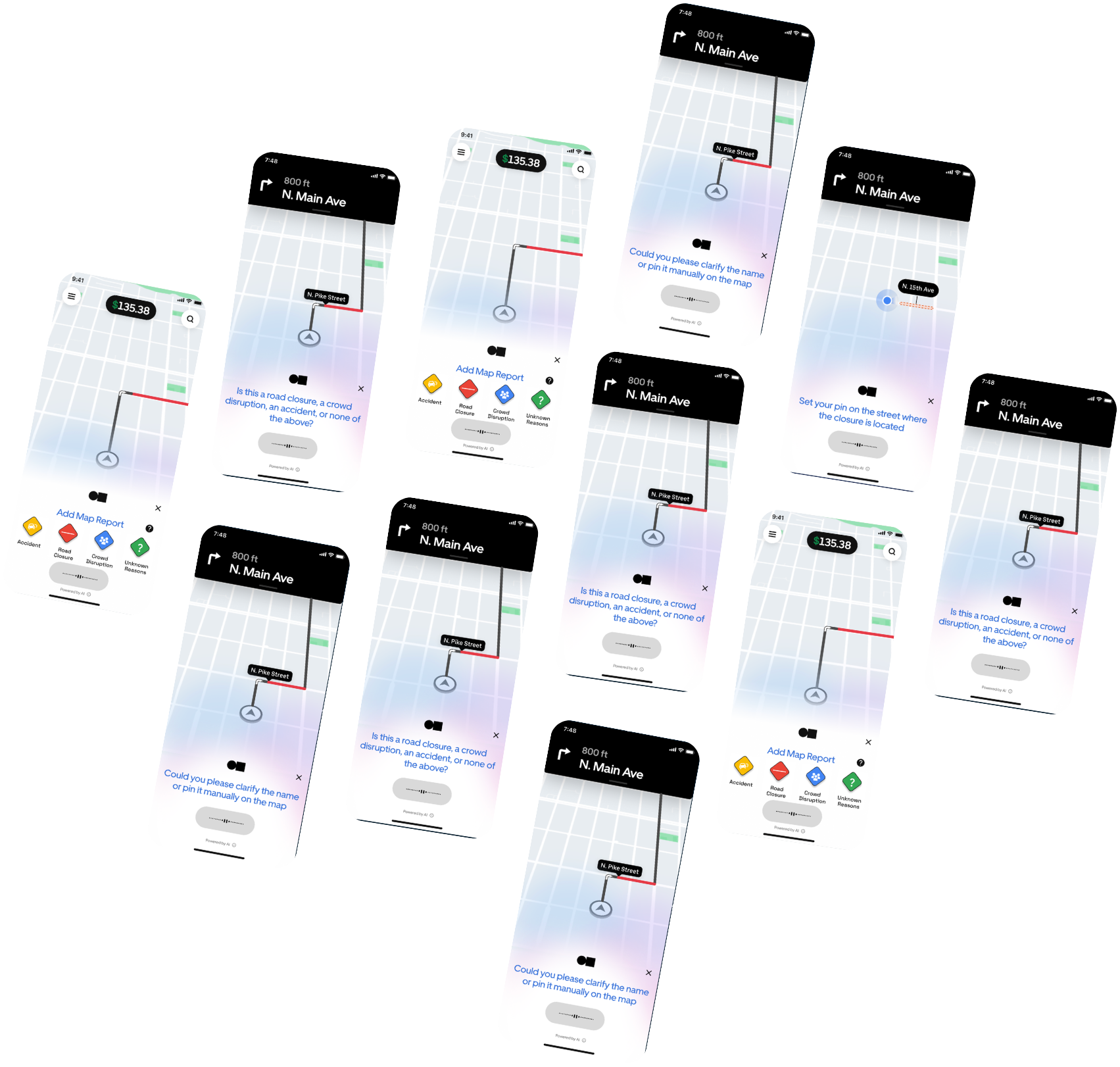
Through Uber’s AI system, Drivers are able to report information real-time to other drivers, while being rerouted immediately without the delay of approval from Uber’s moderation team.
Direct Results
88%
Driver retention rate with remaining in the implemented solution, without manual interference
98%
Company wide-ease of integration, along with Uber’s current AI assistant in its beta stage.
15%
Increase in driver events participation, leading to higher rates of profit for both earners and Uber.
Insights to Features
01
Drivers Want Control In Information Relaying While On The Road
I rallied that information should be communicated by drivers, for drivers. Drivers had a higher likelihood to trust reroutes and information given by those on the road rather than a third-party/Uber themselves.
02
Drivers need Information quickly to make informed real-time decisions
Through Uber’s Conversation AI tool, drivers are given updates on their route ahead without interacting with their devices. The AI tool prepares them to be rerouted with low manual interference.
Unique Event Information Reports
AI Rerouting and Road Blockage Reporting
03
Some Roadblocks are unique to large-scale events, but unavailable on Uber
Drivers recounted the many roadblocks that happen during large-scale events that are beyond Uber’s current reporting system, thus reporting becomes inaccurate. I designed icons and roadblock CTAs that are specific to events
Driver Verification and Road Updates
Process

08
33
out of
SMEs and competitors targeting large-scale events
Who Did I Speak To?
I had a goal of directly understanding what motivated drivers to participate in large-scale events, along with what prevented them with trying
25
33
out of
Active Drivers with more than 3+ years experience online
During these interviews, Drivers often stated the frustration with a lack of control during high-congested moments. Uber lacked proper rerouting support, communication on delays, and information gathering unless approved by backend.
Drivers are forced to navigate multiple apps, while harming their ratings from passengers.

22
33
out of
Active drivers using multiple ride-share apps
Opportunity Matrix
In relations to the potential themes we are aiming to center our design, we have mapped out our 8 overall research insights by implementation effort and driver impact. We determined insights such as drivers highly prioritizing insider networks within the community would yield high rewards, with fairly high effort in implementing said feature.
Design Rationale
As our research progressed, I noticed a consistent pattern: drivers were filling gaps in the system with informal workarounds. The underlying issue was a lack of real-time, actionable and trustworthy information during the moments that matter most. These unreliable guidance affects the drivers’ earnings, ratings and their overall trust in the platform.
Match Point Stress
Drivers wait 30+ minutes for mismatched short rides across venues: "Not taking 4 minutes after half an hour."
Data Debt
Uber drivers form ad-hoc text chains while waiting to share real-time traffic, closures, and hotspots as crowd-sourced control
Spot Logic
Designated zones are unusable in traffic or poorly located (Lumen Field's back lot: "great idea, poor execution").
Exploring Solutions
Based on findings…Drivers have several constraints when navigating large-scale roads; I found that regardless of the solution I move towards, I would have to consider road safety as the highest priority. I have conducted design sprints to direct to several solutions:
“Ghost Frequencies”
P4
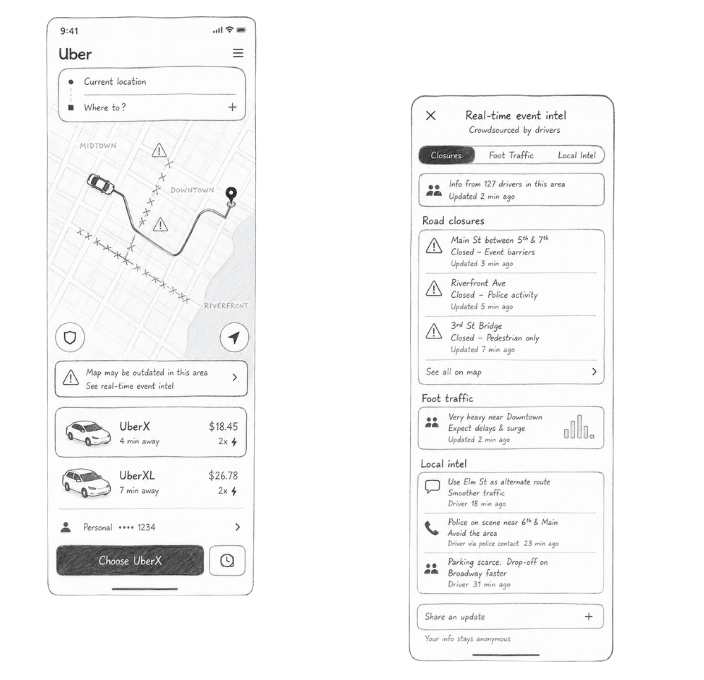
“Sometimes the Uber app picks it up and sometimes it doesn't. I don't know how well they coordinate with the police shutting down streets — more times than not, they don't.”
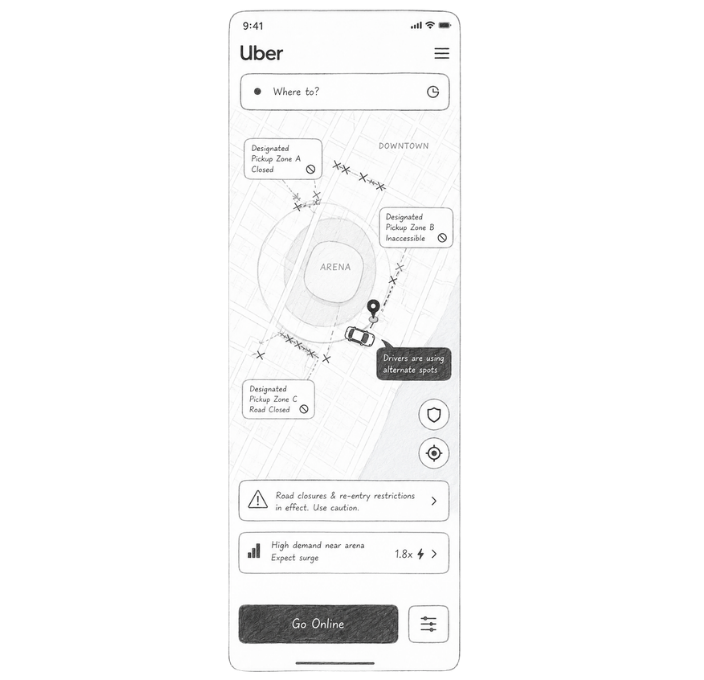
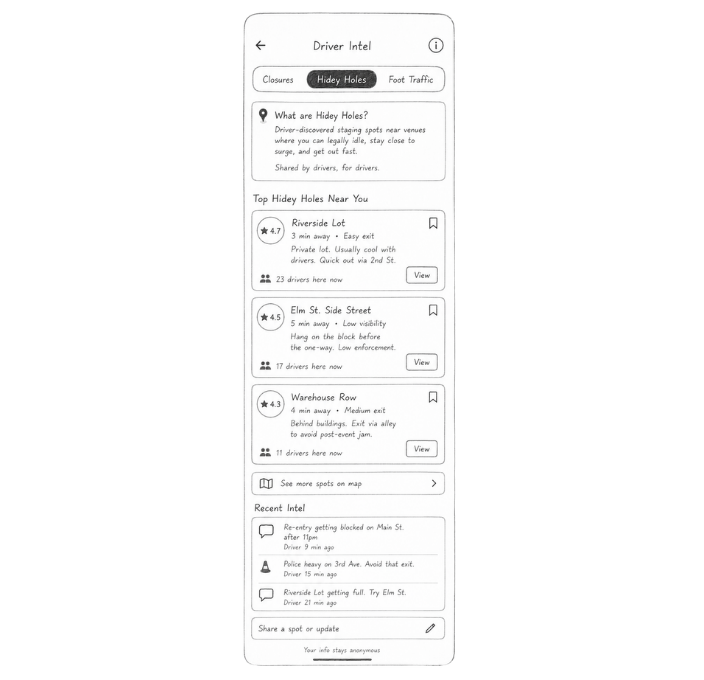
Uber's map data consistently lags behind reality during large events — drivers hit unmarked road closures, make repeated U-turns, and resort to asking passengers to walk. If we integrate a real-time road feed updated by drivers, police, and venue volunteers then drivers will spend less time hitting unmarked closures and rerouting. Currently, the only alert is physically encountering the barricade.
“Street Smarts”
P20
“I let all the other Uber and Lyft drivers get picked up first. When the surcharges go up — that's when I come in.”
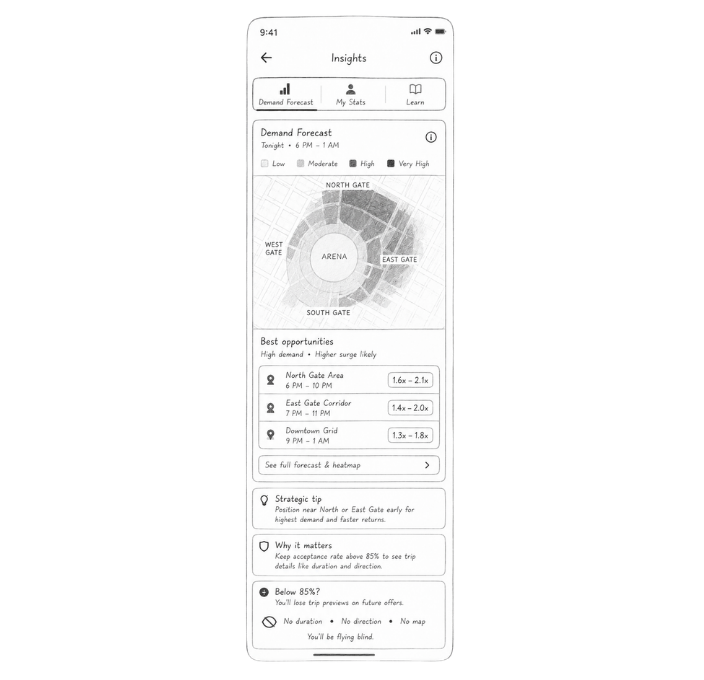
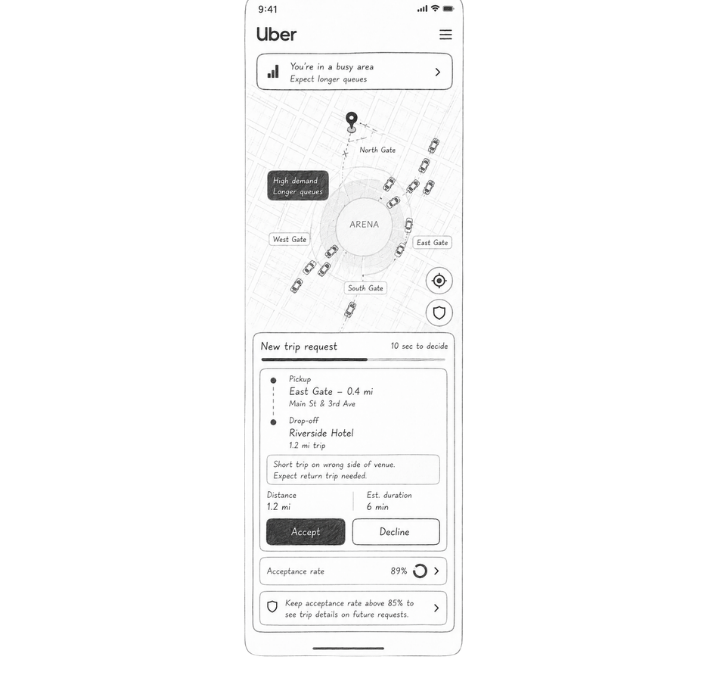
During long queues, Uber often matches them with passengers on the wrong side of the venue for a short trip, and they get roughly 10 seconds to accept or decline. Declining protects their time but tanks their acceptance rate, and dropping below 85% strips away trip preview details like duration and direction, leaving them flying blind on every future offer. Providing pre-event demand forecast around venue areas positions drivers for better strategic choices on routes and surge participation.
“Finding Your Own Fishing Spot”
P17
“I have different little hidey holes around the city for all the large events. After doing this long enough, I can tell you almost down to 50 feet where the surge bubble is going to show up on my map.”
Designated pickup zones technically exist, but they collapse under real event conditions, roads close, re-entry gets blocked, and drivers who tried them once don't return. Instead, experienced drivers develop their own "hidey holes": memorized staging spots near venues where they can legally idle, stay close enough to catch surge pricing, and exit quickly.
Building The AI Voice Assistant
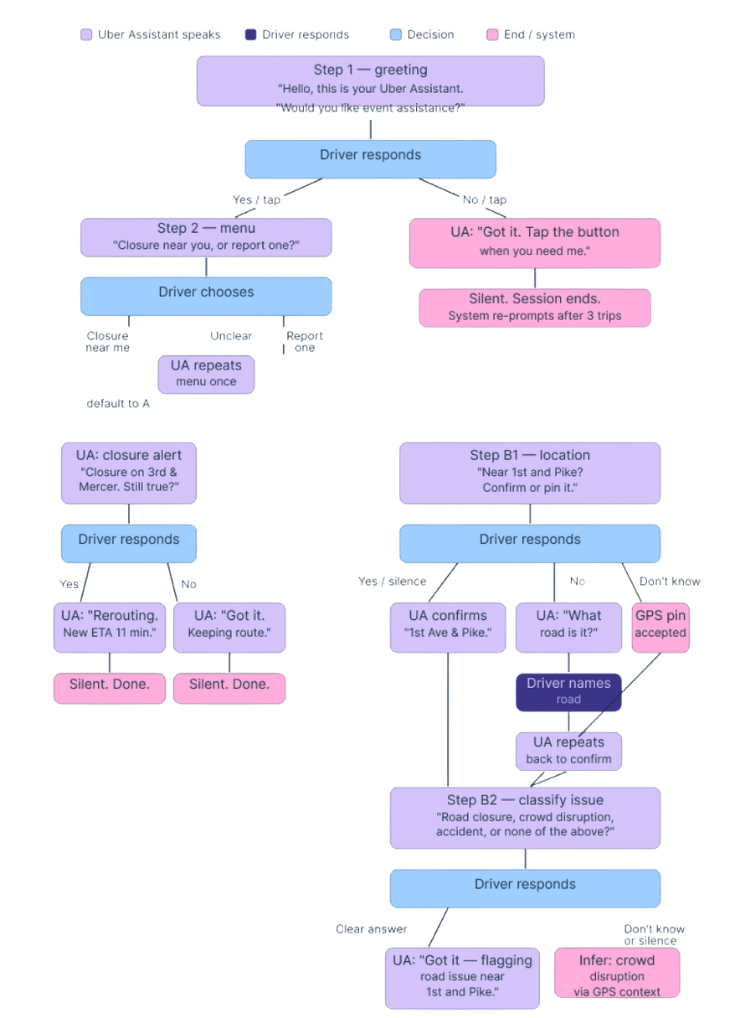
When navigating ElevenLabs, I wrote out questions and answers based on how drivers would navigate the tool. I divided the conversation into two main scenarios: validating (or denying) an upcoming road closure and reporting a new roadblock.
Key Changes Based On Testing
01
02
03
I programmed ElevenLabs to listen to basic commands, such as confirmations and denials. However, Drivers would have full on conversations with the tool, thus I programmed the AI to listen for key phrases.
Conversations were built based on multiple rounds of ride-along testing. I programmed ElevenLabs on common phrases from phone calls, to other competitors.
ElevenLabs had to take into account the location of the driver. I programmed the AI to detect location based changes by combining Claude, and Googles API matching system.
Built as a web app in Next.js and deployed on Vercel. The voice interaction runs live on ElevenLabs, and the map layer uses Mapbox with mocked routing. AI tools (Claude and Claude Code) supported the build, particularly for integrating conversational AI into a working prototype.
Design Feature 1
Design Feature 3
Final Designs
Crowdsourced Validating and Reporting
Our first digital mockup was designed to account for those who want a manual option while also interacting with the Events Assistant. We have included buttons that simply confirm or deny reported road disruptions, while including a voice option. The idea behind this was to include all comfortable experiences for users, without forcing a difficult learning curve.
Due to limitations on Uber’s moderation team, reroutes are heavily discouraged. With Uber’s Events AI assistant, drivers are given ownership on the roads. This would cut their pickup ETA by average of 27%.
Design Feature 2
Unique Reporting for Events
Drivers recounted the many roadblocks that happen during large-scale events that are beyond Uber’s current reporting system, thus reporting becomes inaccurate. I designed icons and roadblock CTAs that are specific to events
Real-Time No Strings Attached Rerouting
Some Takeaways….
Learning Curves
ElevenLabs was a new platform for me. Every step of integration was a learning experience, especially when tying two scenarios together. Our team wrote out a conversation tree and tested different responses with drivers and each other. I had to expand its range of understanding and factor in pronunciations/linguistic barriers. Currently, the prototype understands over 7 languages but can only respond in English. If given the opportunity, I would like to expand the conversation outcome so drivers do not feel entirely constrained with their words.
Too Many Problems…
Drivers brought up event demand and forecast, unfortunately I didn't have time to explore this, but interviews showed drivers want context on events in their city before heading out. The first layer: the Events Assistant triggers before a driver goes online, surfacing where events are, when surge will hit, and the peak hours worth driving for. The more ambitious layer: fuse expected attendance with live driver density, traffic, and surge data to forecast when demand will spike and collapse, so drivers stage at the right moment instead of chasing surge that's already gone.
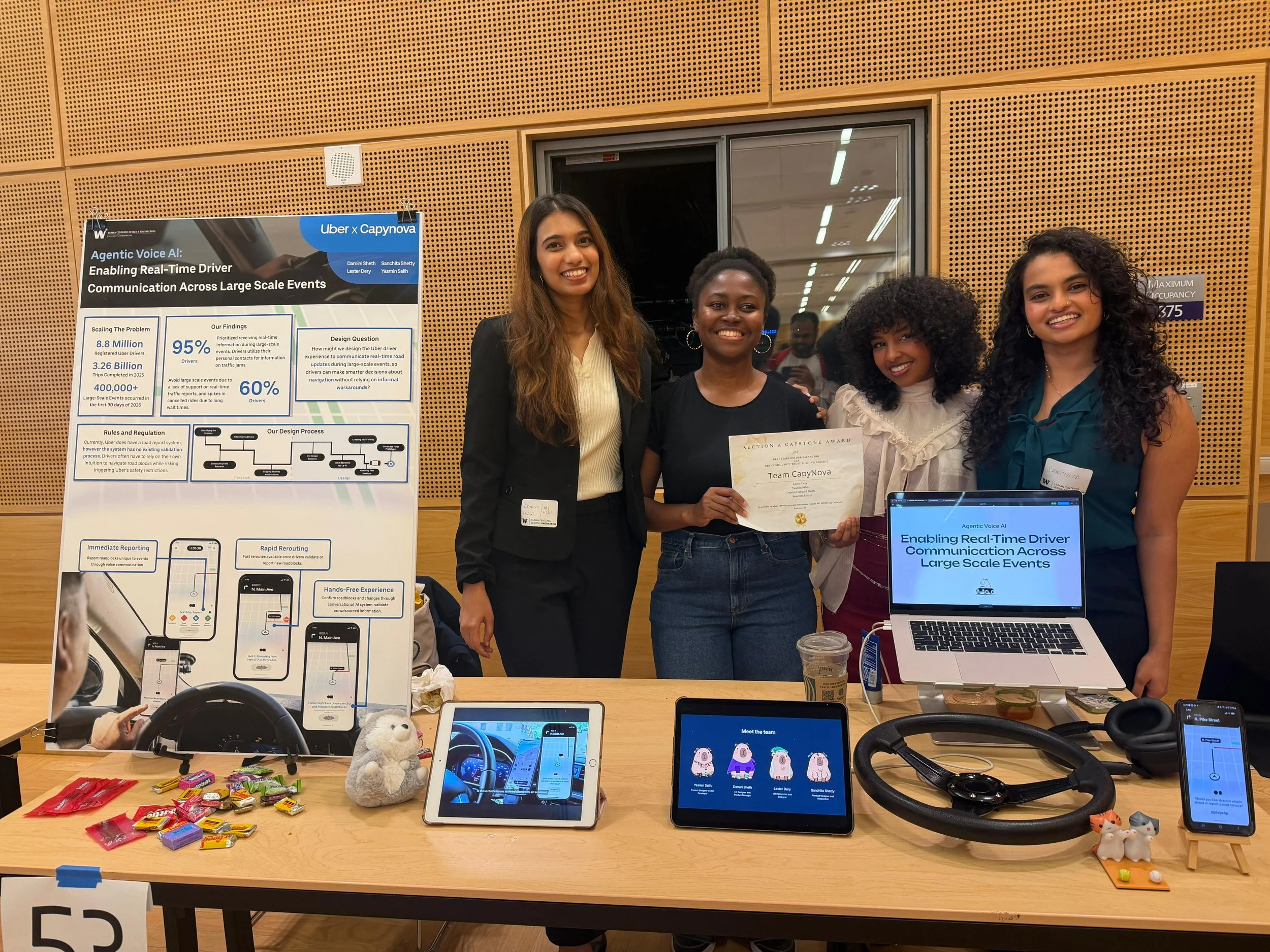
Project Rewarded Best Stakeholder Management and Experimental AI Tools Utilization